
Article · 2026
Trump gives his "complete and total endorsement" to Netanyahu, nine days before the Israeli elections
Translated from the French. Original: davidbenaym.com, October 19, 2026 · French version
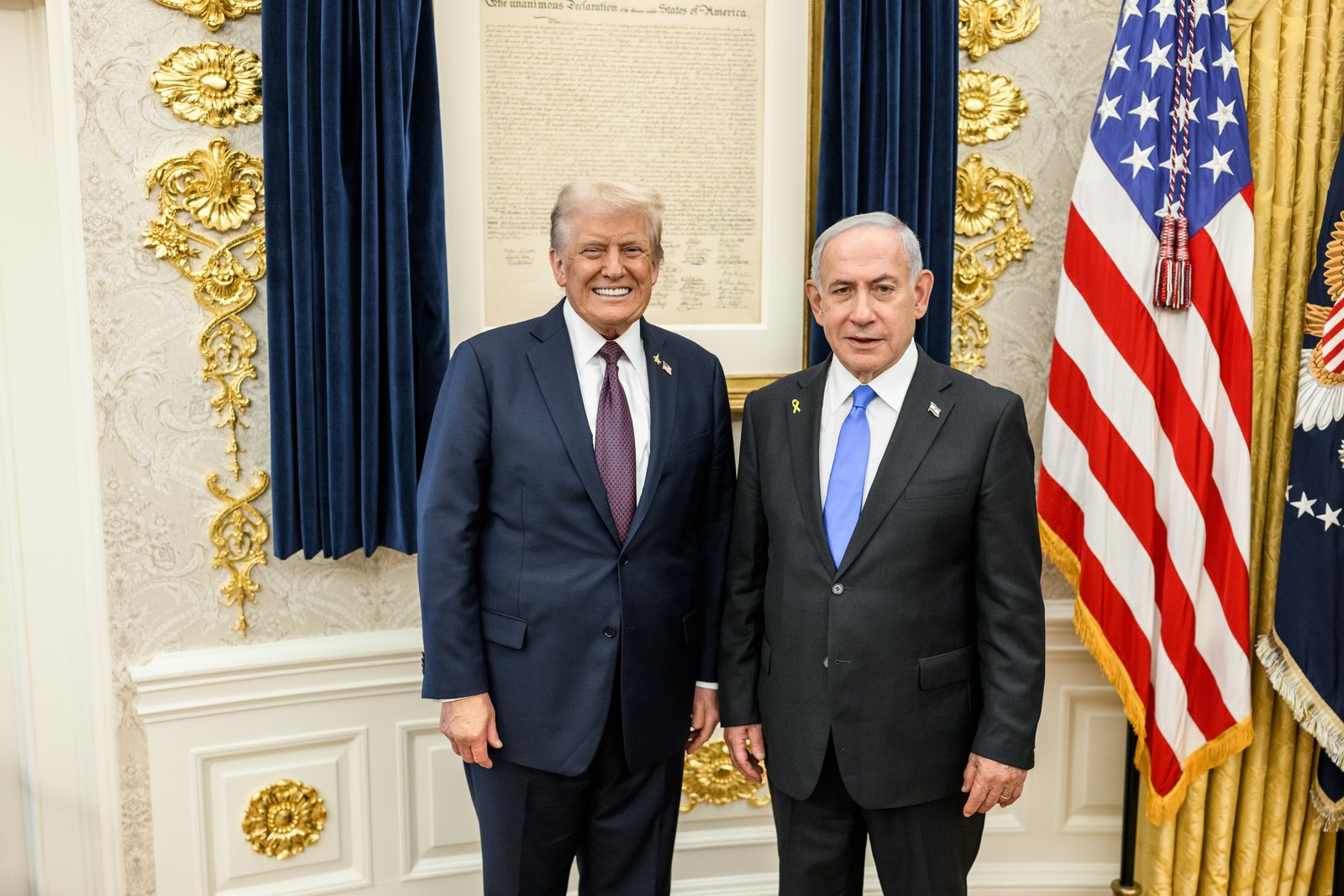
The US president posted a message on his Truth Social network on Sunday, October 18, endorsing Benjamin Netanyahu ahead of the October 27 legislative elections. The Israeli prime minister had been seeking this endorsement for several months. It comes as the polls show no clear majority, and as Donald Trump's popularity in Israel has fallen sharply since the signing of the agreement with Iran in June.
The message is addressed "To the Great People of Israel". In it, Donald Trump calls Benjamin Netanyahu a "Great Warrior Prime Minister" and "an even greater Partner for Peace in combatting the Islamic Republic of Iran". He writes: "Please let this Letter serve to represent my Complete and Total Endorsement of Bibi Netanyahu in his upcoming Race for Re-Election." The US president then ties this endorsement to the Iran question. If Israel chooses "the wrong Leader, which would be anyone other than Bibi, America will have to do this work ourselves, and I am not inclined to do so". The text ends in capital letters: "BIBI NETANYAHU WILL NEVER LET YOU DOWN!"
Donald J. Trump@realDonaldTrumpTruth SocialTo the Great People of Israel:
Bibi Netanyahu has been a Great Warrior Prime Minister, and an even greater Partner for Peace in combatting the Islamic Republic of Iran, with its 51 year old chant, “Death to Israel, Death to America! We will destroy the Little Satan and the Big Satan.” What Country can survive when things such as this are allowed to be said, because eventually, they always end up being true? It would have been only a question of time until Iran would have put that ominous phrase into effect, but they have been systematically destroyed, both Militarily and Financially, and unless they change their ways, rapidly, we will soon finish the job. If Israel has the wrong Leader, which would be anyone other than Bibi, America will have to do this work ourselves, and I am not inclined to do so. Bibi Netanyahu has been Strong, Brave, and Brilliant in the face of tremendous opposition, including that coming from even Israel, itself. Despite all of that, he has endured and, in fact, he has thrived! I have watched Bibi under the most trying of times. Normal men or women in such situations would have wilted under the pressure — But Bibi did not wilt, he actually got stronger, and maintains that same Strength today. This is the kind of Partner that the United States of America is demanding of Israel, a Country for which it has done so much. Please let this Letter serve to represent my Complete and Total Endorsement of Bibi Netanyahu in his upcoming Race for Re-Election as Prime Minister of Israel. BIBI NETANYAHU WILL NEVER LET YOU DOWN! Thank you for your attention to this matter.
DONALD J. TRUMP
PRESIDENT OF THE UNITED STATES OF AMERICA
About seven minutes after the post, according to the Times of Israel, Benjamin Netanyahu thanks the US president on X: "Thank you for the tremendous support and the joint work. Together we will complete the mission." In a video released in Hebrew, he then asks voters to "listen" to Donald Trump and to "vote for [him]".
An endorsement in a race that is still undecided
Donald Trump's endorsement comes as the opinion polls published in Israel point to neither a winner nor a loser. According to the Zman Yisrael poll published on October 15, the Yashar party of former chief of staff Gadi Eisenkot would win 26 seats in the Knesset, against 20 for Likud. The opposition bloc would total 54 seats and the bloc supporting Benjamin Netanyahu 49. Neither camp would reach the 61 seats out of 120 needed to form a governing majority. The outcome will therefore depend on the alliances formed after the vote. A poll published on October 16 by the daily Maariv shows that 48% of respondents consider Gadi Eisenkot better suited to be prime minister, against 41% for Benjamin Netanyahu.
Donald Trump's decision also marks a quick change of position. On Thursday, October 15, three days before his message, he said he had "not even thought" about endorsing a candidate in the Israeli election. The question of the polls had nevertheless already come up between the two men. In August, the American news site Axios reported a scene from late July in the Oval Office. Donald Trump had asked Benjamin Netanyahu where he stood in the polls. An adviser to the Israeli prime minister had answered for him: "Mr. President, he's winning."
A decision taken despite tensions with the president's entourage
This endorsement also comes against a backdrop of strained relations between several people close to Donald Trump and the Israeli prime minister, tensions documented by the American press since last year. In December 2025, during the talks on the Gaza ceasefire, a White House official told Axios: "JD, Marco, Jared, Steve, Susie. He has lost them. The only one he has left is the president." He was referring to Vice President JD Vance, Secretary of State Marco Rubio, the president's son-in-law Jared Kushner, special envoy Steve Witkoff and White House chief of staff Susie Wiles. In August 2026, two senior US officials told the same outlet that Donald Trump liked Benjamin Netanyahu personally, but was frustrated by some of his decisions. According to two people who spoke with him, the president then reportedly summed it up: "Bibi is his own worst enemy."
For its part, the Israeli opposition had asked Washington to stay out of the campaign. According to Axios, people close to Gadi Eisenkot, former prime minister Naftali Bennett and opposition leader Yair Lapid had passed messages to that effect to the US president's entourage. On Sunday evening, on Channel 12, Gadi Eisenkot confirmed this approach: "I asked that there be no interference in Israel's domestic election."
An endorsement whose effect on Israeli voters remains uncertain
The weight of this endorsement will depend on Donald Trump's image among Israelis, which has changed profoundly since the spring. On February 28, 2026, Israel and the United States jointly launch a war against Iran. In early April, Washington and Tehran agree to a ceasefire. On June 17, in Versailles, Donald Trump signs with Iranian President Masoud Pezeshkian the so-called Islamabad memorandum of understanding. The text extends the ceasefire, provides for the reopening of the Strait of Hormuz to shipping and calls for an end to Israeli military operations in Lebanon.
Opinion surveys conducted in Israel then record a drop in confidence in the US president. According to the Jewish People Policy Institute, the share of Israelis who say they have "a great deal of confidence" in Donald Trump falls from 34% in March to 21% in May, then to 12% in early June, after the signing of the agreement. In June, a survey by the Institute for National Security Studies (INSS) shows that 66% of respondents consider the memorandum harmful to Israel's interests. According to a poll by the Hebrew University of Jerusalem and the Agam institute, carried out from June 17 to 20, 69.1% of respondents describe Donald Trump's handling of the war as a "failure" or "poor".
This is not the first time Donald Trump has intervened in an Israeli election campaign in favor of Benjamin Netanyahu. In March 2019, a few days before the April legislative elections, he recognized Israel's sovereignty over the Golan Heights, a decision welcomed at the time by the Israeli prime minister in the middle of his campaign.
The other candidates reacted cautiously. Naftali Bennett, whose party is third in the polls, said on Sunday: "In the end, in international politics, every leader works with whoever is elected."
For Israeli political analyst Amit Segal, this endorsement could indicate that Donald Trump has information the public does not. According to him, the polls carried out in Israel for the White House are "much better for Netanyahu than the Israeli polls". "Trump would not have endorsed someone with no chance of being elected," he says. No official US source has confirmed the existence of these surveys. Israelis go to the polls on October 27.
 Originally published in French on PourChoisir Israël ↗, October 19, 2026