
Article · 2026
Israeli polls: who makes them, and how
Translated from the French. Original: davidbenaym.com, October 20, 2026 · French version
Seven days before the October 27 election, seven pollsters survey Israelis for nine outlets. They do not ask the same people, or in the same way. Who makes the polls, and how.
On the evening of Monday, October 19, Channel 12 gives 24 seats to Yashar, Gadi Eisenkot's party, and 21 to Likud. The outgoing coalition parties total 51 seats. The same evening, Channel 14 gives 30 seats to Likud, 19 to Yashar and 62 to the right-wing bloc. Same bloc, same evening, an 11-seat gap.

Three keys to read the fact sheets
Respondents and people contacted. A poll of 500 people does not mean the pollster called only 500 people. It contacts many more, and only some of them answer. On October 12, Channel 12 contacts 2,521 people and gets 509 answers, one in five. On October 7, Next Data contacts 14,983 for 1,079 answers, or 7%. The lower this rate, the more the sample has to be adjusted.
Undecided voters. Each pollster asks them its own question, then chooses either to allocate them among the parties or to set them aside. That choice can shift several seats.
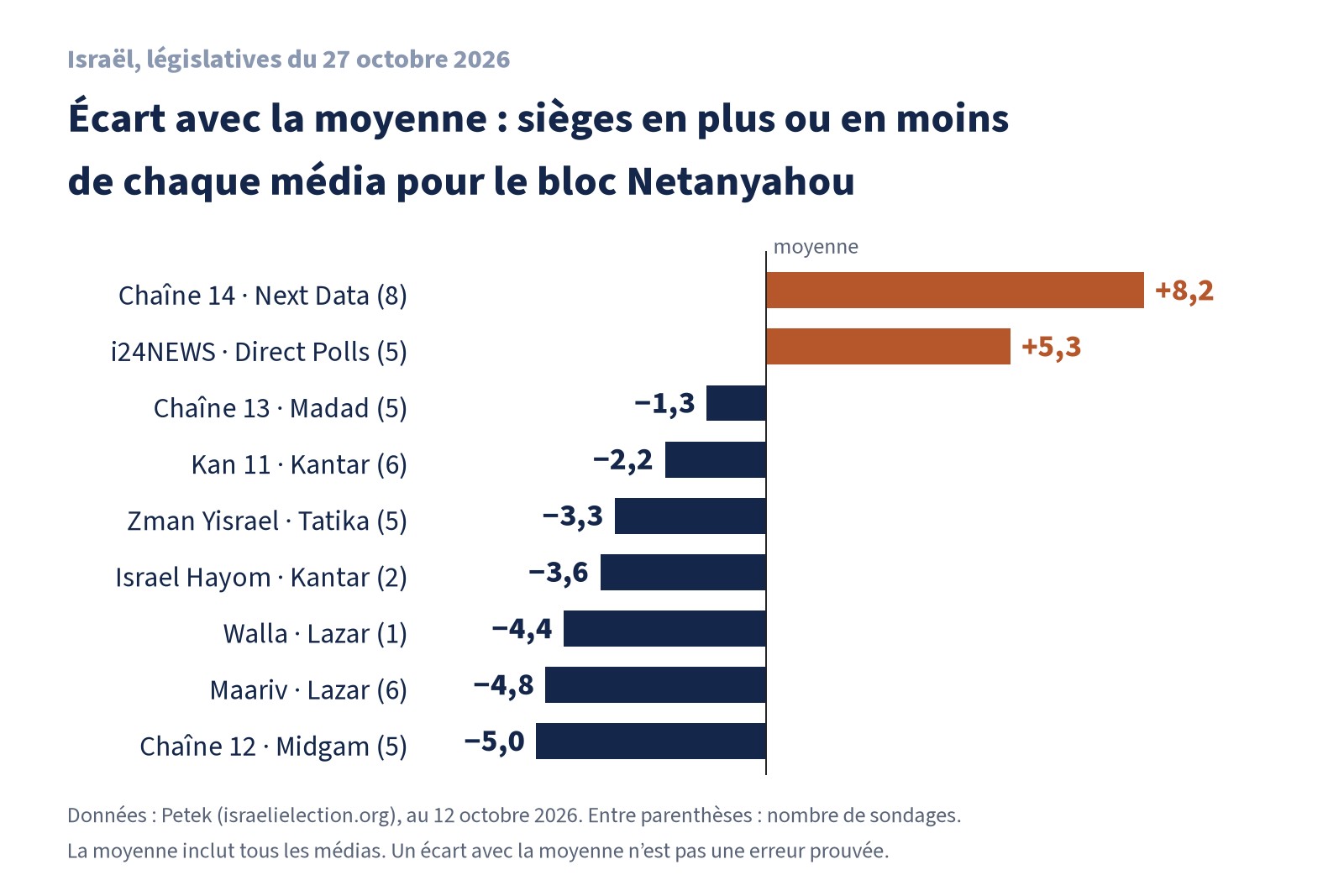
The gap with the average. It shows whether an outlet usually gives the Netanyahu bloc more or fewer seats than the polling average. For example, +8 for Channel 14 means 8 seats more than the average. The figures come from the Petek aggregator, as of October 12. A gap does not mean a pollster is wrong: only the vote will tell.
The overview
| Outlet | Pollster | Method | Sample | Undecided | Gap |
|---|---|---|---|---|---|
| Channel 12 (N12) | Midgam | Online and phone | 507 respondents of 2,502 contacted · 4.4% margin | About 8%, assigned to parties by a model | −5.0 |
| Channel 13 | Madad | Three online panels | 1,016 respondents · 3.1% margin | Asked which way they lean; 4.3% with no lean, kept apart | −1.3 |
| Kan 11 · Israel Hayom | Kantar | Online sample | 551 respondents of 2,489 contacted (Israel Hayom) · 4.2% margin | 30% not yet decided (Kan); method not published | −2.2 · −3.6 |
| Maariv · Walla | Lazar | Online panel, phone top-ups | 700 respondents · 3.7% margin | Asked which party is closest; 5.2% | −4.8 · −4.4 |
| Zman Yisrael | Tatika | Online panel | 500 respondents · 4.4% margin | Separate question at times; method not published | −3.3 |
| i24NEWS | Direct Polls | Own online panel | 525 respondents · 4.2-point margin | Assigned to their usual bloc; share not published | +5.3 |
| Channel 14 | Next Data | Digital collection | 454 respondents · margin absent from reports (3% on October 7) | Allocated in the seat map; 0.9% “undecided” on October 7 | +8.2 |
Latest poll from each outlet. Gap: seats above or below the average for the Netanyahu bloc, Petek calculation as of October 12. For Kan and Israel Hayom, Maariv and Walla, the first figure is the first outlet’s. Petek ↗
Pollster by pollster
Channel 12 (N12)
Midgam
- Who
- Mano Geva heads the Midgam institute. Its polls air on Channel 12 and on N12, the mako website.
- How
- Online and by phone. The phone is used to reach Haredim, Arabs and older people, who are less present online. The sample is stratified and matched to Central Bureau of Statistics data.
- Sample
- 507 respondents out of 2,502 people contacted on October 19, about one in five. Margin of error of 4.4%.
- What it publishes
- The number of people contacted, the breakdown of undecided voters, and lists below the threshold: Amcha Yisrael at 2.8% and the Reservists at 2.1% on October 19.
- What it does not publish
- Its weighting, that is, the weight it gives each group in the population.
- Undecided
- About 8% on October 12. Most hesitate between two parties of the same bloc. 3.1% have no idea. A statistical model assigns them to parties. Mano Geva says he assigns about 97% of them this way.
- Record
- In April 2019, it gives Likud 26 seats; Likud wins 35. In 2022, its campaign polls underestimate the coalition by 6.4 seats on average. Its final poll gives it 60 seats; it wins 64.
Channel 13
The Madad
- Who
- Shmuel Rosner, a commentator on the channel, and Noah Slepkov. The Madad has been Channel 13’s pollster since June 2026.
- How
- Three panels, mostly online: Ariel Ayalon’s Project Midgam for the non-Haredi Jewish population, Dudi Dror’s Askaria for Haredim, Yosef Makleda’s StatNet for Arabs. Each week, respondents are drawn at random, under quotas for past vote, religiosity and Haredi subgroups.
- Sample
- 1,016 respondents on October 19, 3.1% margin. On September 2: 566 non-Haredi Jews, 224 Haredim and 150 Arabs. Haredim are overrepresented, which implies reweighting.
- What it publishes
- The most detail of all: results by camp, by party, between Jews and Arabs, between Haredim and non-Haredim, likelihood to vote, and a simulation if two small lists fall below the threshold.
- What it does not publish
- The number of people contacted, its weighting.
- Undecided
- It asks for a first and second choice. Those who answer “I don’t know” are asked which party they lean toward. In late September, 13% do not know, but 8% have a lean. Those with no lean are kept apart: 4.3% on October 13.
- Record
- A new team, with no record in this form. Before it, Channel 13 works with Camil Fuchs, a co-founder of the Madad. In 2022, his polls underestimate the coalition by 6.5 seats on average.
Kan 11 and Israel Hayom
Kantar
- Who
- Dudu Hasid heads Kantar Israel. Its polls air on Kan 11, the public broadcaster, and run in the daily Israel Hayom.
- How
- An online sample, Arabs included.
- Sample
- In September, 551 respondents out of 2,489 people contacted, or 22%. 4.2% margin.
- What it publishes
- Israel Hayom gives the number of people contacted. Kan’s October 18 article names neither the pollster, nor the sample, nor the margin.
- What it does not publish
- How it surveys Haredim and what share of the sample they make up, its weighting.
- Undecided
- Kan publishes a separate question. On October 18, 30% say they have not yet decided, including voters who have chosen their bloc but not their party. 26% are considering not voting. How they enter the seat calculation is not published.
- Record
- In 2022, Dudu Hasid’s polls underestimate the coalition by 4.9 seats on average. His final poll gives it 60 seats. Israel Hayom’s gap rests on only two polls.
Maariv and Walla
Lazar
- Who
- Menachem Lazar, a social psychologist, heads Lazar Research. He has been Maariv’s pollster for ten years.
- How
- An online panel, Panel4All. He adds phone interviews among Haredim and Arabs to check that he is heading in the right direction, he tells Globes.
- Sample
- 500 to 1,000 adults according to Maariv’s methodology page, margin of 3.1 to 4.4%. 700 respondents on October 16.
- What it publishes
- The share of undecided voters.
- What it does not publish
- The number of people contacted, its weighting.
- Undecided
- He asks a follow-up question: which party is closest to you? A party named as second choice counts less than a first choice. Outside campaigns, he sets undecided voters aside. He counts 5.2% on October 16.
- Record
- In 2022, he has the lowest average error per party of the seven pollsters studied by the Madad: 1.6 seats. On the coalition, he is off by 5.4 seats on average over the campaign. Walla’s gap rests on a single poll.
Zman Yisrael (Times of Israel)
Tatika
- Who
- Yossi Tatika, a political consultant. He has run campaigns for Likud as well as the Labor Party. With him is Roy Schindler, owner of the Adgenda panel and a former director general of the Labor Party. Their company dates from March 2025.
- How
- An online panel, Adgenda. The sample is broken down by age, religion, gender and region.
- Sample
- 500 respondents, Jews and Arabs, 4.4% margin.
- What it publishes
- Lists below the threshold: Amcha Yisrael at 2.8% on October 15.
- What it does not publish
- The number of people contacted, its weighting, how it surveys Haredim and what share of the sample they make up.
- Undecided
- It sometimes asks a separate question. In May, 70% have chosen their party, 17% only their bloc, 14% nothing. How they enter the seat calculation is not published.
- Record
- Too new to have an electoral record.
i24NEWS
Direct Polls
- Who
- Zuriel Sharon, 42, owner of Direct Polls. He starts out in 2014 on Reuven Rivlin’s digital campaign for the presidency. In 2015, he works on Likud’s campaign. In 2019, he founds Direct Polls with Shlomo Filber, as equal partners. In 2025, he buys out Filber’s stake and becomes i24NEWS’s pollster.
- How
- Its own online panel, with no subcontractor and no phone. i24NEWS describes a digital system combined with a panel. In 2022, the firm says online panels miss older immigrants from the former Soviet Union who do not speak Hebrew, and Arab Likud voters.
- Sample
- 525 respondents on October 18, 4.2-point margin.
- What it publishes
- Lists below the threshold: Amcha Yisrael at 2.9% and the Reservists at 2.4%.
- What it does not publish
- The number of people contacted, its weighting.
- Undecided
- It starts from an assumption. An undecided voter ends up voting for a party of their usual bloc, or stays home. In his view, shifts from one bloc to the other do not exceed 2 to 5 seats. He argues that leaving undecided voters out favors the opposition, since most voted for the coalition in 2022. Their share does not appear in i24NEWS articles.
- Record
- The best on the coalition in 2022: its polls underestimate it by 3.5 seats on average, and its final poll gives it 62 seats; it wins 64. In April 2019, its final poll is off by 36 seats in total and gives the right-wing bloc 67 seats; it wins 65.
Channel 14
Next Data
- Who
- A company set up in late 2025 by the group that owns the channel. Its director, Netanel Siman-Tov, represents the owner, Yitzhak Mirilashvili. Haaretz reveals this in May 2026, from the companies register. Shlomo Filber, a former director general of the Communications Ministry and co-founder of Direct Polls, analyzes its polls on air.
- How
- Digital collection online, with a stratified analysis.
- Sample
- Highly variable, from 450 to more than 2,000 respondents depending on the week. 454 respondents on October 19. On October 7, 1,079 respondents out of 14,983 people contacted, or 7%, with a 3% margin of error.
- What it publishes
- In its filings with the elections committee, the number of people contacted and its margin. It only files its polls in August, after a request from the Movement for Freedom of Information.
- What it does not publish
- Its margin of error in on-air and online reports, its weighting.
- Undecided
- Its filings state that the raw percentages do not account for the distribution of undecided voters or for the Bader-Ofer calculation, the rule that allocates leftover seats. The seat map therefore does distribute undecided voters. It publishes neither the question asked nor its formula. On October 7, only 0.9% “undecided” remain in its raw figures.
- Record
- Set up in late 2025, the company has no electoral record.
In 2025, on Channel 14, Shlomo Filber defends his method. In his view, other pollsters give too much weight to Arabs, about 20% of the sample, when they weigh less among voters.
Why the numbers diverge
The channel. An online panel brings together volunteers who signed up in advance. It reaches fewer Haredim without internet, older people and some Arabs. On the phone, many people no longer pick up. Midgam mixes both. Lazar adds phone calls. The Madad uses specialized panels.
The weight of each group. Each pollster decides the share of Arabs or Haredim based on the turnout it expects. Menachem Lazar gives Globes the example of Arabs: 20% of the sample for one, 15% or 10% for another. None publishes its formula. The Israel Policy Forum makes the same point in August.
Undecided voters. Depending on the question, 4% to 30% of respondents say they are undecided. Most pollsters follow up (“which party do you lean toward?”) and assign them based on the answer, sometimes on their past vote. The Madad keeps those with no lean apart. Midgam, Next Data and Direct Polls allocate them through a model or an assumption. None publishes its formula.
The threshold. A list at 3.25% gets at least four seats. Below that, none. With 500 respondents, the margin of error is about 4.4%, or five seats. Four lists hover around the threshold. The same voters can therefore be worth four seats or zero.
The gap with the average. Two outlets are above it, Channel 14 and i24NEWS. The others are below, by 1.3 to 5 seats. Petek’s average includes those two outlets. Without them, the Netanyahu bloc goes from 54.1 to 52.1 seats, and the others’ gap shrinks by about two seats.
The past calls for caution both ways. In 2022, the coalition wins 64 seats. Campaign polls underestimate it by 5.7 seats on average, according to the Madad, and the closest are Direct Polls'. The same year, the last ten polls all put Meretz above the threshold. It does not enter the Knesset.
The law, in brief
The 1959 elections law requires each poll to be published with who commissioned it, who conducted it, the dates, the population, the number of people contacted and of respondents, and the margin of error. The pollster also files its method with the Central Elections Committee. No pollster publishes its raw data.
No new poll may be published from the end of Friday, October 23, until polling stations close on Tuesday, October 27 at 10 p.m. Israel time. Polls published by Friday will be the last.
How to read them until the 27th
Shmuel Rosner advises looking at where polls agree, since those are the findings one can trust more, he tells the Times of Israel. Today, six outlets agree on one point: no camp reaches 61 seats. Only Channel 14 gives the Netanyahu bloc a majority.
In French, the site PourChoisir Israël collects each outlet's latest poll, with its source, and flags what is missing. I have published there before. Its October 20 average puts Yashar at 22.2 seats and Likud at 21.6.
Sources: PourChoisir Israël, polls ↗ (October 20, 2026) · Petek, average and house effects ↗ (October 12, 2026) · ice, Channel 12 poll ↗ (October 20, 2026) · N12, methodology box ↗ (October 12, 2026) · Globes, why polls diverge ↗ (July 30, 2026) · Haaretz, Channel 12 and 13 polls ↗ (October 19, 2026) · Walla, Channel 13 poll ↗ (October 20, 2026) · The Madad, October 14 poll ↗ (October 14, 2026) · The Madad, September 2 poll ↗ (September 2, 2026) · The Madad, interview with David Steinberg ↗ (September 4, 2026) · The Madad, about ↗ (October 20, 2026) · Kan, October 18 poll ↗ (October 18, 2026) · Israel Hayom, August Kantar poll ↗ (August 6, 2026) · Israel Hayom, September Kantar poll ↗ (September 17, 2026) · Maariv, polling methodology ↗ (August 18, 2026) · Jerusalem Post, Maariv poll ↗ (October 16, 2026) · Zman Yisrael, Tatika poll ↗ (July 23, 2026) · Times of Israel, Zman Yisrael poll ↗ (October 15, 2026) · i24NEWS, Direct Polls poll ↗ (October 18, 2026) · Haredim10, Direct Polls and panels ↗ (October 28, 2022) · Haredim10, Direct Polls sale ↗ (June 11, 2025) · Newsrael, Channel 14 poll ↗ (October 19, 2026) · Elections committee, Next Data filing ↗ (September 8, 2026) · Haaretz, Channel 14 and Next Data ↗ (May 18, 2026) · Channel 14, Shlomo Filber on samples ↗ (May 9, 2025) · Israel Policy Forum, polls and pollsters ↗ (August 20, 2026) · The Madad, 2022 poll accuracy ↗ (October 20, 2026) · Knesset Jeremy, April 2019 scorecard ↗ (June 6, 2019) · Elections law, section 16E ↗ (October 20, 2026) · Central Elections Committee, letter ↗ (July 28, 2026) · Times of Israel, three experts ↗ (October 17, 2026) · Wikipedia, pollsters and polls ↗ (October 20, 2026) · N12, Midgam and its undecided model ↗ (October 20, 2026) · The Madad, undecided voters and their lean ↗ (October 20, 2026) · 103FM, Menachem Lazar on undecided voters ↗ (October 20, 2026) · Zman Yisrael, undecided question ↗ (October 20, 2026) · Globes, interview with Zuriel Sharon ↗ (October 20, 2026) · Elections committee, Next Data October 7 filing ↗ (October 7, 2026) · Movement for Freedom of Information, Next Data and Direct Polls ↗ (August 16, 2026)