
La Dernière Heure · 2003
Anniversary of the Kennedy assassination: the American media’s angle
Translated from the French. Original: La Dernière Heure, November 21, 2003 · French version

Anniversary of the Kennedy assassination:
The American media’s angle
(21/11/2003)
SPECIAL CORRESPONDENT IN NEW YORK,
The presidential convertible rolls slowly through the streets of Dallas, shots are heard, the camera stammers, right, left, then follows the motorcade again, the car speeds up, a wave of panic sets in, the crowd flees the main road. These images were seen again and again around the world at lightning speed at the time of the events. Before this event, large-scale television broadcasts were timed to the millimetre, as for the coronation of Queen Elizabeth II in 1952. The impact of JFK’s death was global, and it was also a new era of journalism that began on November 22, 1963.
Today, 40 years later, the assassination of John Fitzgerald Kennedy still stirs emotions. The American press remembers that day as one of the most traumatic in the country’s history. Comparisons with September 11, 2001 abound in terms of emotional impact. The most popular dailies retrace the day of his death minute by minute, like a film rolled out to better digest the event. Some interview seniors who remember what they were doing when they learned of their president’s death, and everyone has an anecdote, an unforgettable memory. Politicians, actors, journalists: this whole little world jostles on television sets to tell its own personal story.
Local tabloids, sensationalist shows, specialist magazines: many keep talking about JFK only through the day of his death. Even a respectable network like ABC is airing a two-hour special on new evidence supporting the idea of a conspiracy behind the official version of the Warren Commission (named after the judge in charge of the inquiry at the time). Peter Jennings, one of the stars of the small screen and anchor of the evening news, promises an investigation bringing together more than 70 interviews and exceptional footage for a high-audience prime time.
The highly reputed Life magazine has brought out a reprint of the issue published in November 1962 in tribute to Kennedy. The conspiracy theory staged by Oliver Stone in 1991 in his Oscar-winning “JFK” is resurfacing on movie channels and in supermarket bins as a remastered DVD.
Yet other television networks such as CBS or NBC are starting to take stock of Kennedy’s life. The History Channel is running a huge advertising campaign for its three-hour documentary broadcast throughout what the channel calls “Kennedy week”. Its pitch is explicit: “Four times in just three years America nearly went to war with the Soviet Union, and three times the Kennedy administration could have sent the army into southern states to protect the civil rights of Black citizens.” The cable channel is trying in its own way to carry out its duty of remembrance in the face of media coverage often too focused on the man’s death rather than on his political role.
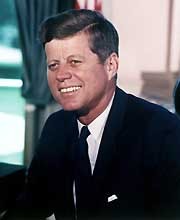
Ben Bradlee, a Newsweek journalist during JFK’s term and later executive editor of the Washington Post during the Watergate affair, signs a report on the first “TV President”. He analyses with finesse the role of television and the press throughout JFK’s political career. Just as de Gaulle knew how to tame the media in France, Kennedy seems to have been the first to turn his television appearances into mini events. His relaxed style, his Hollywood smile, his youth and his political tactics made the difference. Today, media America returns the favour. And it seems the recipe still works.
D.B.
© La Dernière Heure 2003